Is Higher Fucoidan Purity Always Better? 5 Things to Know Before You Buy
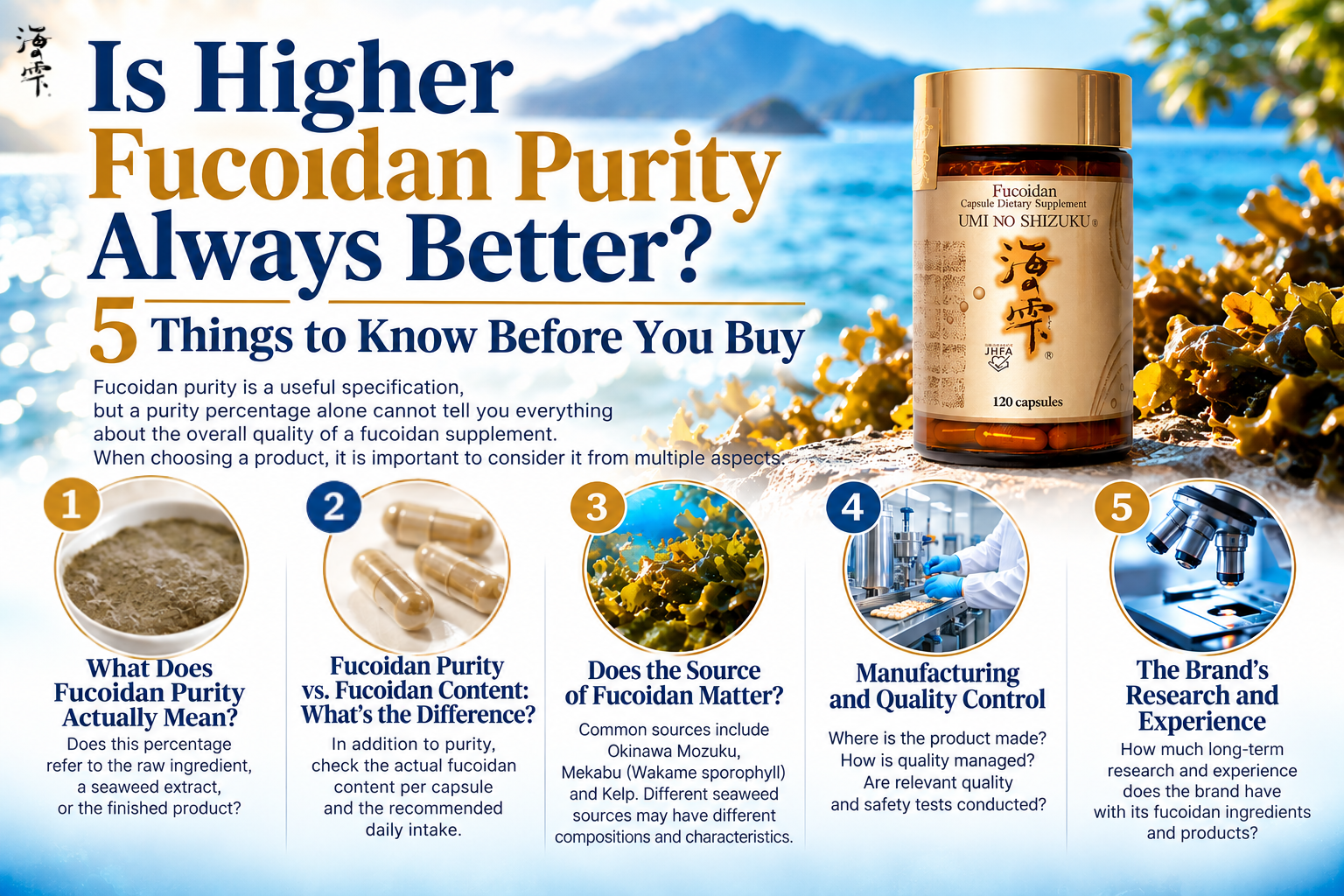
Is Higher Fucoidan Purity Always Better? 5 Things to Know Before You Buy
When comparing fucoidan supplements, one of the first specifications you may notice is fucoidan purity. Some products are marketed as “high purity” or “high concentration,” while others display a percentage for the fucoidan ingredient they use.
But does a higher fucoidan purity percentage necessarily mean a better product?
Not necessarily. Fucoidan purity is a useful specification, but it should not be evaluated on its own.
To understand a fucoidan supplement more completely, it is also important to consider:
▪️ the actual amount of fucoidan in the finished product
▪️ the type and origin of brown seaweed used
▪️ the formulation
▪️ manufacturing and quality control
▪️ the brand’s research and experience with its ingredients
So before comparing two purity percentages, start with a more important question:
What exactly does the stated fucoidan purity percentage represent?
1. What Does Fucoidan Purity Actually Mean?
Fucoidan is a type of sulfated polysaccharide naturally found in brown seaweed. Common sources include Okinawa Mozuku, Mekabu (the sporophyll of Wakame seaweed), and Kelp.
Brown seaweed naturally contains many different components. To produce a fucoidan-rich ingredient, the seaweed typically undergoes processes such as extraction, separation and purification.
Therefore, when you see a fucoidan product displaying “XX% purity,” the first step should not be to immediately compare which product has the higher number.
Instead, ask:
What exactly does this percentage describe?
For example:
▪️ Is it a specification of the fucoidan raw ingredient?
▪️ Does it describe the composition of a particular brown seaweed extract?
▪️ Or is it a specification of the finished product?
There is nothing inherently wrong with using a percentage to describe fucoidan purity. What matters is whether the definition and basis of that percentage are clearly explained.
Only when you understand what the number represents does the comparison become meaningful.
2. Fucoidan Purity vs. Fucoidan Content: What’s the Difference?
This is one of the most important distinctions to understand when comparing fucoidan supplements.
Even if a product uses a high-purity fucoidan ingredient, it does not mean that the entire capsule consists of fucoidan.
The finished product may also contain other formulation ingredients, as well as the capsule shell itself.
Therefore, in addition to looking at the purity percentage, you should also ask:
How much fucoidan is actually stated per capsule?
For example:
Purity: XX%
This describes a particular specification of the fucoidan ingredient.
Fucoidan content: 212.5 mg per capsule
This describes the stated amount of fucoidan contained in the finished product.
These two figures answer different questions and should not be directly compared as if they were the same measurement.
When choosing a fucoidan supplement, it is helpful to consider these three factors separately:
Fucoidan Purity + Fucoidan Content per Capsule + Recommended Daily Intake
Looking at all three gives you a clearer picture of the product than focusing on a “high purity” percentage alone.
3. Does the Source of Fucoidan Matter?
Fucoidan does not come from just one type of brown seaweed.
Common sources include:
▪️ Okinawa Mozuku
▪️ Mekabu (Wakame sporophyll)
▪️ Kelp
Fucoidan derived from different types of brown seaweed may vary in its composition and structural characteristics.
Therefore, even if two fucoidan supplements display similar purity percentages, it does not necessarily mean that the fucoidan ingredients they contain are identical.
When comparing products, consider asking:
▪️ What type of brown seaweed is the fucoidan derived from?
▪️ Where are the raw ingredients sourced?
▪️ Does the product use fucoidan from a single seaweed source, or does it combine fucoidan from different sources?
Considering the source, actual fucoidan content and purity together provides a more complete picture than comparing a single percentage.
4. Why Manufacturing and Quality Control Matter
For a nutritional supplement intended for long-term use, ingredient specifications are only one part of overall product quality.
Every stage—from raw material sourcing and manufacturing to finished-product testing—is worth considering.
When comparing fucoidan supplements, look for information such as:
Where is the product manufactured?
▪️ Is the source of the raw ingredients clearly identified?
▪️ How are product specifications managed?
▪️ Are appropriate quality and safety tests conducted?
▪️ Does the brand provide sufficient product information?
“High purity” can be a useful product specification, but it cannot replace a comprehensive approach to manufacturing and quality control.
What matters is not only how pure the ingredient is, but also:
How is that ingredient made into the supplement you take every day?
5. Consider the Brand’s Fucoidan Research and Experience
This is something we place particular importance on at Umi No Shizuku.
A brand can source fucoidan ingredients and formulate them into a finished product. It can also continue investing time over many years to better understand the ingredients and formulations it uses.
For Umi No Shizuku, scientific research is not simply about citing published fucoidan studies in our product information.
We also believe in continuing to participate in relevant research and scientific exchange.
Umi No Shizuku has focused on fucoidan since 2002.
Since 2012, Umi No Shizuku and research teams have participated in scientific exchanges related to IMMUNOLOGY™, the annual meeting of the American Association of Immunologists (AAI), continuing to build research knowledge and experience related to fucoidan.
We believe that:
If we are committed to a product for the long term, we should also continue to deepen our understanding of its ingredients, formulation and development.
How to Choose a Fucoidan Supplement: 5 Questions to Ask
Choosing a fucoidan supplement does not have to mean looking for the product with the biggest purity number.
When you see “high purity” or an impressive percentage, consider asking these five questions:
1. Purity
What exactly does the percentage represent?
Does it describe the raw fucoidan ingredient, a seaweed extract, or the finished product?
2. Fucoidan Content
How much fucoidan is actually stated per capsule?
Look at the actual amount of fucoidan in the finished product rather than relying on a purity percentage alone.
3. Source
What type of brown seaweed is used, and where does it come from?
Understanding the seaweed source provides important context when comparing fucoidan ingredients.
4. Quality
Where is the product manufactured, and how is its quality managed and tested?
Manufacturing standards and quality control are important parts of understanding the finished supplement.
5. Research and Experience
How much long-term research and product-development experience does the brand have with the ingredients it uses?
When these five areas are clearly explained, a “XX% purity” figure becomes more meaningful because you can understand it in the context of the product as a whole.
How Does Umi No Shizuku Approach Fucoidan Purity?
At Umi No Shizuku, we do not consider purity unimportant.
On the contrary, ingredient specifications are an important part of understanding product quality.
However, we believe that a fucoidan supplement should not be defined by a single percentage alone.
Since we began focusing on fucoidan in 2002, Umi No Shizuku has considered multiple factors in product development and our long-term commitment to fucoidan, including:
▪️brown seaweed source
▪️actual fucoidan content
▪️product formulation
▪️manufacturing in Japan
▪️quality control and testing
▪️long-term commitment to research
For example, each capsule of Umi No Shizuku Fucoidan contains:
212.5 mg of fucoidan per capsule
Our fucoidan is derived from:
Japanese Okinawa Mozuku + Mekabu (Wakame sporophyll)
The formulation also contains Brazilian Agaricus mycelium.
We want consumers to look beyond a single impressive number.
Instead, we want them to clearly understand:
Where the product comes from, what it contains, and how the brand approaches its manufacturing, quality management and ongoing understanding of the product.
Frequently Asked Questions About Fucoidan Purity
1. Is higher fucoidan purity always better?
Not necessarily. A purity percentage can provide useful information about a particular ingredient specification, but it should not be used on its own to judge an entire fucoidan supplement.
It is also important to consider the actual fucoidan content, seaweed source, formulation, manufacturing and quality control.
2. What is the difference between fucoidan purity and fucoidan content?
Fucoidan purity generally describes a specification of the raw ingredient or extract.
Fucoidan content describes the stated amount of fucoidan contained in the finished product—for example, the number of milligrams per capsule.
They provide different types of information and should not be treated as the same measurement.
3. What should I look for when choosing a fucoidan supplement?
Consider five key areas:
Fucoidan purity, actual fucoidan content, seaweed source, manufacturing and quality control, and the brand’s long-term research and product experience.
Looking at these factors together can provide a more complete understanding of the product.
4. What type of seaweed does fucoidan come from?
Fucoidan occurs naturally in different types of brown seaweed.
Common sources include Okinawa Mozuku, Mekabu (Wakame sporophyll), and Kelp.
Fucoidan from different brown seaweed sources may vary in composition and structural characteristics.
Compare the Full Picture Before Choosing a Fucoidan Supplement
Purity is a number. Product quality involves a much bigger picture.
When comparing fucoidan supplements, consider these factors together:
Fucoidan Purity × Actual Fucoidan Content × Seaweed Source × Formulation × Manufacturing × Quality Control × Research
Fucoidan purity is certainly worth considering.
But it is only one part of the information needed to understand a fucoidan product as a whole.
Numbers can help us begin a comparison.
Understanding what those numbers represent helps us make a more informed choice.
【Explore Our 4 Umi No Shizuku Fucoidan Products】
【Learn About Umi No Shizuku Quality Control】
【Explore Umi No Shizuku Fucoidan Research】
【Contact Our Hong Kong Team on WhatsApp】
